
Table of Contents
- TLDR
- Why Static Clings Work for Food Businesses
- Static Clings vs. Adhesive Window Stickers
- Promote Seasonal Drinks and Menu Items
- Make Limited-Time Offers Easy to Change
- Show Holiday and Special Hours
- Direct Pickup and Delivery Customers
- Add QR Codes Without Crowding the Window
- Use Inside-Mount Graphics When Possible
- Design for People Who Are Moving
- Match the Design to the Restaurant
- Choose the Right Size and Placement
- Apply Static Clings Correctly
- Store Removed Clings for Reuse
- Know When Static Clings Are Not the Best Choice
- Build a Reusable Promotion Kit
- Restaurant Window Checklist
- Final Thoughts
- FAQs
TLDR
Static clings give restaurants and coffee shops a simple way to update window messaging without applying permanent adhesive. Use them for seasonal drinks, limited-time menus, holiday hours, pickup instructions, events, hiring notices, and QR codes.
The best static clings use short copy, large type, strong contrast, and a clear call to action. Apply them to clean, smooth glass, and store removed pieces flat on their original backing when you plan to reuse them.
For permanent hours, logos, or long-term outdoor branding, an adhesive window sticker may be a better choice.
A restaurant window has to do several jobs at once. It introduces the business, shows whether the dining room is open, promotes current offers, and helps customers figure out where to order or pick up food.
The challenge is that many of those messages change. A pumpkin drink may last six weeks. A watch party happens once. Holiday hours need to disappear in January, preferably before Valentine’s Day.
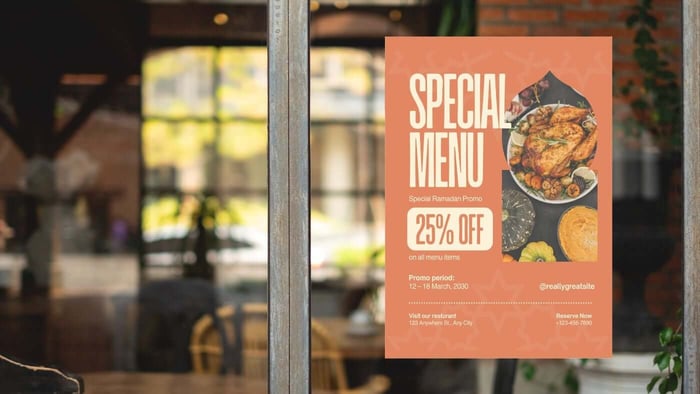
That is where static clings are useful. They attach to smooth glass without ordinary adhesive, making them practical for temporary restaurant and coffee shop signage. They can be removed cleanly when the promotion ends, and carefully stored pieces may be used again.
Why Static Clings Work for Food Businesses
Restaurants change faster than most storefronts.
Menus rotate. Seasonal drinks return. Patio hours shift. Events are added. Delivery procedures change. A permanent sign cannot handle every temporary message without the front window becoming crowded.
Static clings help solve that problem because they are designed for short-term graphics on smooth surfaces such as glass. CustomStickers describes them as adhesive-free clings that remove cleanly and work well for storefront promotions and temporary signage.
That makes them useful when a message needs to look intentional but does not deserve a permanent installation.
Common uses include:
Seasonal food and drink promotions
Holiday hours
New menu launches
Happy hour messaging
Loyalty program reminders
QR code menus
Pickup and delivery instructions
Catering promotions
Hiring notices
Live music and trivia nights
Sports watch parties
Private event notices
Patio information
Limited-time discounts
The key is to treat the glass as a changing communication space rather than a place to fit every message the business has ever used.
Static Clings vs. Adhesive Window Stickers
These removable graphics and clear stickers can look similar, but they solve different problems.
| Feature | Static Clings | Adhesive Window Stickers |
|---|---|---|
| How they attach | Cling to smooth glass without ordinary adhesive | Use pressure-sensitive adhesive |
| Best use | Temporary promotions and changing information | Long-term branding and permanent details |
| Removal | Designed to remove cleanly | Removable, but intended for a longer installation |
| Repositioning | Often easier during initial placement | Usually less forgiving after full application |
| Outdoor exposure | Better protected when mounted inside glass | Better choice for many long-term exterior uses |
| Common restaurant use | Seasonal menus, events, holiday hours | Logos, standard hours, long-term QR codes |
Use static clings when the message is temporary. Use adhesive graphics when it needs to remain in place for months or years.
A restaurant could use a permanent clear sticker for its logo and regular hours, then add removable graphics around it for rotating offers. CustomStickers distinguishes adhesive-free clings from clear stickers, which use adhesive and are intended for longer-term use.
Promote Seasonal Drinks and Menu Items
Coffee shops and restaurants depend on timely offers.
Window graphics can announce:
Pumpkin and apple drinks
Peppermint or gingerbread specials
Summer lemonades
Frozen drinks
Seasonal desserts
Lent or holiday menus
Limited sandwiches
New sauces
Weekend brunch
Restaurant week participation
Keep the design focused on one product or category. A window graphic that tries to list twelve drinks, six prices, ingredients, and a rewards message will be difficult to read from the sidewalk.
A better message might be:
Strawberry Matcha Is Back
Or:
Weekend Brunch
Saturday and Sunday
9 a.m. to 2 p.m.
Let the window create interest. The full menu can remain on the door, counter, or website.
Make Limited-Time Offers Easy to Change
Temporary offers are one of the strongest reasons to use static clings.
A restaurant can rotate graphics for:
Buy-one-get-one offers
Free drink upgrades
Student discounts
Kids-eat-free nights
Loyalty bonuses
Game-day specials
Late-night menus
Fundraising nights
Grand-opening promotions
Include an end date when the offer is short. Customers should not need to ask whether a window promotion from last season is still active.
Also remove expired signage promptly. A clean window with one current offer creates more confidence than a crowded window filled with promotions nobody remembers approving.
Show Holiday and Special Hours
Customers often check the door before checking a website.
Removable window graphics make it easier to post:
Thanksgiving hours
Christmas and New Year schedules
Temporary closures
Private event hours
Summer schedules
Winter hours
Renovation notices
Staff training closures
Use large text and avoid vague wording.
Instead of:
Special Hours This Week
Write:
Closing at 3 p.m. Friday
Closed Saturday
Open Sunday at 8 a.m.
Include the exact dates. A sign that says “Closed Monday” becomes confusing when it remains on the window for several weeks.
Direct Pickup and Delivery Customers
Pickup customers often arrive while reading an order message, carrying a phone, or trying to find the correct entrance.
Use static clings to identify:
Online order pickup
Delivery driver entrance
Curbside check-in
Catering pickup
Mobile order shelves
Separate café and dining entrances
Where to wait
Which phone number to call
Directional messaging should be brief:
Mobile Pickup Inside
Delivery Drivers: Use Side Door
Curbside Pickup: Call 555-0142
Place the graphic where the decision occurs. A pickup sign on the wrong door may be attractive, but it is not helping.
Add QR Codes Without Crowding the Window
QR codes can connect customers to:
Online menus
Ordering
Reservations
Loyalty signup
Catering forms
Event calendars
Gift cards
Nutrition or allergen pages
Job applications
A QR code needs a clear label. “Scan Me” is less useful than “Scan to Order” or “Scan for Today’s Menu.”
Keep open space around the code and test the final printed size through the glass. Reflections, tinted windows, bright sunlight, and viewing distance can all affect scanning.
For a code that will remain in place throughout the year, an adhesive QR code sticker may make more sense. For a holiday menu or short campaign, static clings let the restaurant remove the code with the rest of the promotion.
Use Inside-Mount Graphics When Possible
Restaurant windows face weather, cleaning, fingerprints, and people brushing against the glass.
Inside-mount static clings can protect the printed graphic while allowing it to be read from outside. This setup may require reverse printing so the design reads correctly through the window.
Inside mounting can help protect the piece from:
Rain
Snow
Wind
Street dirt
Casual tampering
Exterior window cleaning
But the design must account for the glass itself. Dark tint can reduce visibility, and ordinary color ink may look translucent without a white layer behind it. CustomStickers notes that face-cling graphics intended for inside mounting may need reverse printing and a white layer to remain visible through glass.
When ordering custom window clings, explain whether the graphic will be viewed from outside and mounted to the inside face of the window. Review the proof for orientation, color, white ink, and cut shape before approving it. CustomStickers provides a proof and allows revisions before production.
Design for People Who Are Moving
Most customers will not study a restaurant window like a museum label.
They may be walking past, driving slowly, carrying bags, or looking through reflections. Good static clings communicate quickly.
Use:
A short headline
Large type
High contrast
One main image
One call to action
Simple dates and times
Plenty of empty space
Avoid:
Long paragraphs
Thin script fonts
Low-contrast colors
Several competing promotions
Tiny QR codes
Detailed pricing tables
Important text near the cut edge
Print a paper mockup at the intended size and tape it to the window. Then view it from the sidewalk. If the message cannot be understood in a few seconds, simplify it.
Match the Design to the Restaurant
The design should feel connected to the business.
A neighborhood coffee shop may use hand-drawn illustrations and warm colors. A modern fast-casual restaurant may prefer bold type and simple product photography. A bakery may use seasonal patterns that coordinate with its boxes and labels.
Keep these elements consistent:
Logo
Colors
Typography
Photography
Illustration style
Tone of voice
Consistency matters even when the message changes. Customers should recognize the business before they finish reading the offer.
CustomStickers can print the business name, logo, contact information, store hours, slogans, and other custom artwork, then provide a proof for review before production.
Choose the Right Size and Placement
The correct size depends on viewing distance and available glass.
Small graphics work well near a door handle or service counter. Larger graphics are better for street-facing promotions.
Possible placements include:
Front entrance door
Main storefront window
Drive-thru window
Pickup window
Counter sneeze guard
Refrigerated display case
Interior glass partition
Pastry case
Mirror
Menu display glass
Do not cover required safety markings, accessibility signs, door hardware, or the customer’s view into the business. Keep graphics away from edges where seals, frames, and condensation may interfere with contact.
Use one large focal message rather than scattering many small pieces across the window.
Apply Static Clings Correctly
The surface should be smooth, clean, and dry.
Before installation:
Remove dust and grease from the glass.
Clean away fingerprints and food residue.
Let the surface dry completely.
Confirm the orientation before removing the backing.
Position one edge first.
Smooth the material across the glass.
Push out trapped air with a soft squeegee or card.
Check every edge.
Avoid applying static clings to textured glass, brick, unfinished wood, fabric, or rough walls. They need close contact with a smooth surface.
If the graphic begins lifting, clean both the window and cling before trying again. Grease and dust are common problems in food-service spaces.
Store Removed Clings for Reuse
Some static clings can be reused if they remain clean and undamaged.
When removing one:
Lift an edge gently.
Avoid stretching the material.
Place it back on the original liner.
Keep the printed surface clean.
Store it flat.
Avoid high heat.
Label the backing with the promotion or season.
Do not fold the cling or place several pieces together without liners. Creases, dust, and stuck surfaces can make the next installation much harder.
A labeled storage folder can keep annual holiday hours, seasonal promotions, and recurring event signs ready for the next use.
Know When Static Clings Are Not the Best Choice
Static clings are useful, but they are not a universal replacement for signs and stickers.
Choose another product when:
The graphic needs to stay up for years.
The surface is rough or textured.
The application is fully outdoors.
The area receives strong wind or frequent moisture.
The window has heavy tint that reduces visibility.
The graphic will be handled constantly.
The design needs to attach to a wall, box, or countertop.
Tamper resistance matters.
For permanent glass branding, clear adhesive stickers for windows provide a stronger long-term bond. For temporary indoor promotions on smooth glass, static clings remain the more flexible option.
Build a Reusable Promotion Kit
Restaurants can save time by creating a small library of recurring graphics.
A practical kit might include:
Holiday hours
Now hiring
Patio open
Patio closed
Online ordering
Pickup entrance
Private event
Sold out
New seasonal menu
Gift cards available
Catering available
Trivia night
Live music
Watch party
Store each design on its backing and label it clearly.
The kit prevents staff from making a handwritten sign every time the schedule changes. It also keeps the storefront consistent across shifts and locations.
Restaurant Window Checklist
Before ordering or installing static clings, confirm:
The message is temporary.
The surface is smooth glass.
The design can be read quickly.
Dates and hours are correct.
The logo and colors match the brand.
The viewing side is clear.
Reverse printing is set up when needed.
White ink is included when needed for visibility.
QR codes have been tested.
The size works from the sidewalk.
The placement does not block required signage.
The glass is clean and dry.
Removed graphics have a storage plan.
A short review before printing prevents a promotion from arriving backward, unreadable, or too small.
Final Thoughts
Static clings give restaurants and coffee shops a practical way to keep storefront messaging current without committing every promotion to permanent adhesive.
Use them for seasonal drinks, limited menus, holiday hours, events, QR codes, hiring signs, and pickup directions. Keep each design short, readable, and focused on one action.
And know when to choose something else. Permanent hours and logos usually deserve a longer-term adhesive graphic. Short campaigns and changing details are where static clings do their best work.
A restaurant window should look current, not crowded. With a small library of well-designed graphics, the business can update what customers see without rebuilding the entire storefront every season.
FAQs
What Are Static Clings?
Static clings are thin graphics designed to attach to smooth surfaces such as glass without ordinary adhesive. They are commonly used for temporary window messages and point-of-purchase displays.
Are Static Clings Good for Restaurant Windows?
Yes. Static clings are useful for seasonal offers, holiday hours, events, pickup directions, hiring messages, and other temporary information. They work best on clean, smooth glass.
Can Static Clings Be Reused?
They may be reusable when removed carefully, returned to their liner, kept clean, and stored flat. Damage, dust, heat, and creasing can reduce how well they cling later.
Should a Restaurant Use Inside- or Outside-Mount Clings?
Inside mounting can protect the graphic from weather and tampering. The artwork may need to be reverse printed so customers outside can read it correctly.
Will Static Clings Work on Tinted Windows?
They can, but visibility may be reduced. Strong contrast and a white ink layer behind colored artwork can help. Review a proof and test the design against the actual glass when possible.