
Table of Contents
- Why Sticker Size Matters
- Sticker Sizing Guide by Common Use
- How Custom Sticker Sizes Are Measured
- Best Sticker Sizes for Everyday Use
- Best Sticker Sizes for Packaging and Product Labels
- Die Cut Stickers vs. Sticker Sheets
- How Design Detail Changes Sticker Size
- Safe Margins, Borders, and Bleed
- Quick Sticker Size Decision Guide
- Common Sticker Sizing Mistakes
- Conclusion
- FAQs
TLDR
The safest all-purpose sticker size is usually 3 inches on the longest side.
Our sizing policy is based on the longest side of your design, so a 3-inch sticker means the longest part of the finished sticker will be about 3 inches.
Use 1 to 2 inches for packaging seals, small product labels, QR codes, and simple logo marks. This sticker sizing guide treats these as small-format stickers.
Use 4 to 6 inches for detailed artwork, car windows, gear cases, and bold promotional stickers.
This sticker sizing guide helps you pick a practical size before you order, not after you see a proof that feels off.
A sticker can be a quarter inch away from looking right. Too small, and the details disappear. Too large, and the sticker feels harder to place. That is why a clear sticker size guide matters before you upload artwork, choose a quantity, or approve a proof.
The right size depends on three things: where the sticker will go, how far away people will view it, and how much detail the design needs. This sticker sizing guide gives you common sticker dimensions, practical examples, and a simple way to choose the right size for your project.
Why Sticker Size Matters
Sticker size affects more than price. It changes how readable the design is, how easy the sticker is to apply, and whether someone will actually use it. A good sticker sizing guide should make that choice feel less like a guess.
A 2-inch logo sticker can look polished on a candle box or mailer. The same 2-inch sticker may look too small on a laptop if the logo includes fine text. A 5-inch sticker can look great on a hard case or car window, but it may feel too large for a water bottle.
That is the main lesson of this sticker sizing guide: start with the surface. Instead of asking, “What is the standard sticker size?” ask, “Where will someone put this?” The answer usually points you toward the right range.
Sticker Sizing Guide by Common Use
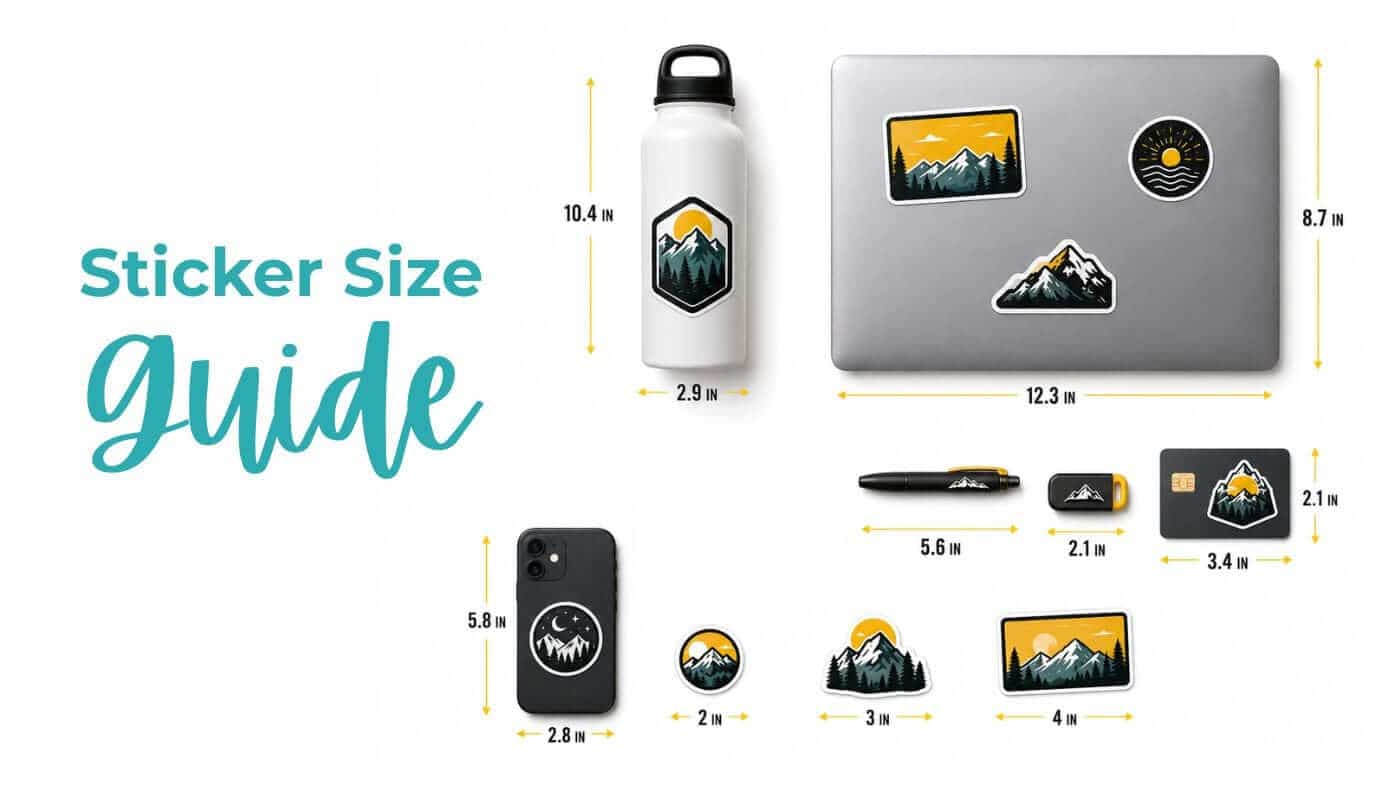
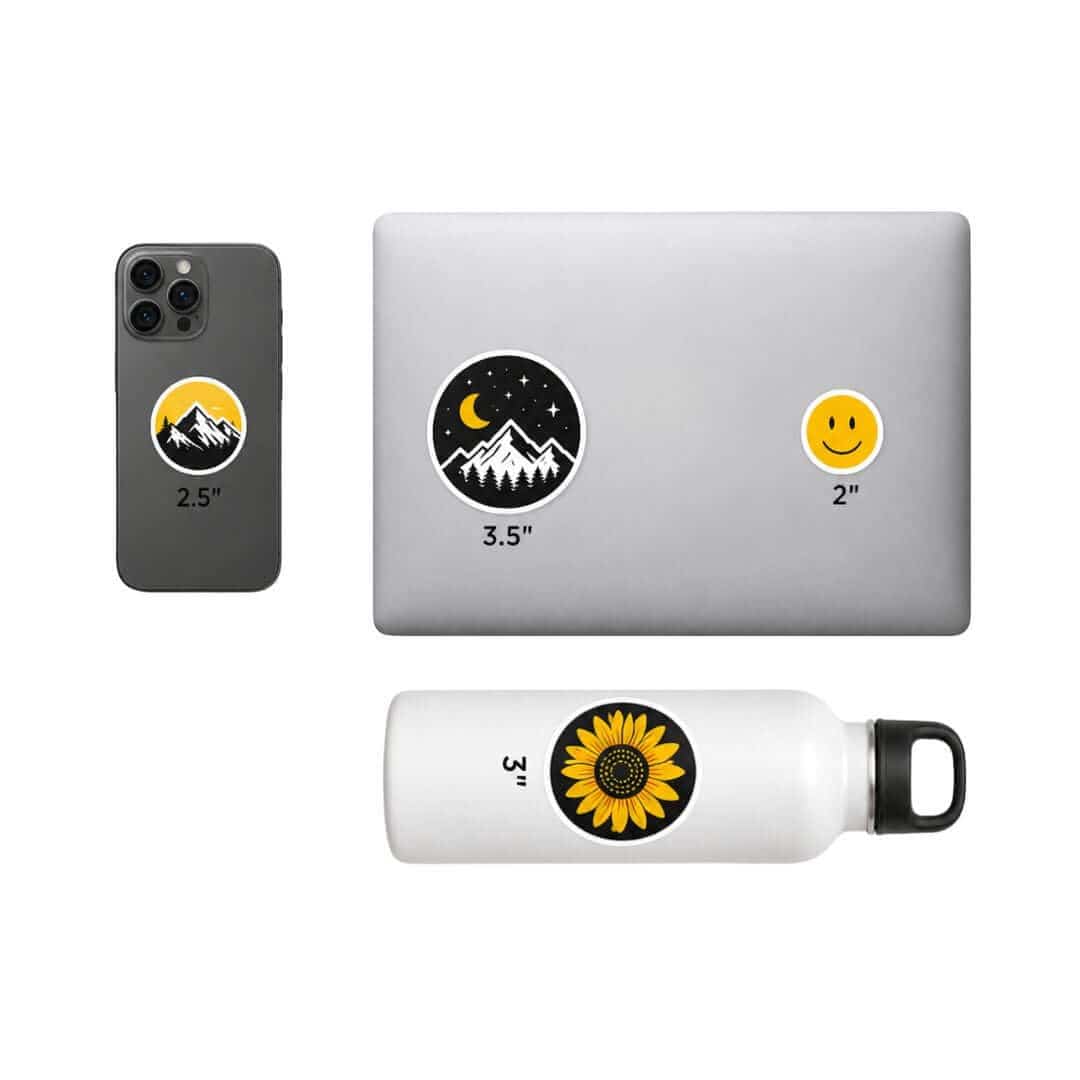
There is no single correct sticker size, but there are reliable starting points. Use this sticker sizing guide chart as a reference.
| Use Case | Good Starting Size | Why It Works |
|---|---|---|
| Laptop stickers | 2.5" to 4" | Enough room for art without taking over the laptop |
| Water bottle stickers | 2" to 3.5" | Easier to apply on curved surfaces |
| Packaging seals | 1" to 2" | Clean, simple, and quick to apply |
| Product labels | 2" to 4" | Room for branding and basic product details |
| Event giveaways | 2.5" to 3" | Useful on many common surfaces |
| Car window stickers | 4" to 6" or larger | Better visibility from a distance |
| Bumper stickers | Around 3.75" x 7.5" or 3" x 11.5" | Wide enough for short text |
| Sticker sheets | Sheet size varies | Best for several small designs together |
If you only remember one part of this sticker sizing guide, remember that these numbers are starting points, not rules. A bold mascot can work at 2.5 inches. A detailed illustration may need 4 inches. The artwork should make the final call.
How Custom Sticker Sizes Are Measured
Our sizing policy is simple: custom sticker sizes are based on the longest side of your design. That means if you order a 3-inch custom sticker, the longest part of the finished sticker will be about 3 inches. The other side will scale proportionally based on the shape of your artwork.
This is an important detail in any sticker sizing guide because different shapes can feel very different at the same listed size. A 3-inch circle has more visual weight than a 3-inch wide wordmark. A tall mascot, a square logo, and a wide business name may all be ordered at 3 inches, but the finished stickers will not take up the same amount of space.
For example, if your design is a tall rectangle and you order it at 4 inches, the height will be about 4 inches. If your design is a wide logo and you order it at 4 inches, the width will be about 4 inches. The proof will show how the final shape and cutline work together before production.
This sticker sizing guide recommends checking the shape before choosing the size. If your design is wide and short, you may want to size up slightly so it does not feel too small. If your design is compact, round, or square, a smaller size may still look substantial.
A quick test helps. Print your artwork on plain paper at 100% scale. Cut it out and place it on the item. It is not fancy, but it catches sizing problems before production.
Best Sticker Sizes for Everyday Use
For everyday stickers, 3 inches is usually the safest starting point. It is large enough for most logos, characters, illustrations, and short phrases, but it still fits on laptops, tumblers, notebooks, helmets, coolers, and hard cases.
A 2-inch sticker is better for simple icons, small logo marks, minimalist artwork, packaging inserts, and lower-cost handouts. The tradeoff is detail. Thin lines, tiny type, and complex backgrounds can get lost at that size.
A 4-inch sticker gives the artwork more presence. Use it when the design has texture, small elements, or a shape that needs more space. A 4-inch sticker also works well for outdoor gear, binders, car windows, and larger promotional stickers.
This sticker sizing guide uses 3 inches as the everyday default because it works across the most situations. But if the design includes a lot of text, start larger.
Circle Stickers
$21.99
Description Custom Circle Stickers Custom Stickers are the full-color, contour-shaped classic. Our circle stickers are a fast and easy way to promote your business, brand, or event. Printed on generously thick, durable vinyl with a weatherproof laminate coating - your stickers are… read more

Best Sticker Sizes for Packaging and Product Labels
The packaging section of this sticker sizing guide starts with one point: packaging stickers do not always need to be big. In many cases, the goal is to seal, label, organize, or add a small branded detail without overwhelming the package.
For packaging seals, 1-inch to 2-inch circle stickers are usually enough. A 1-inch seal feels subtle and tidy. A 2-inch seal gives more room for a logo, short phrase, or seasonal design.
For product labels, the right sticker dimensions depend on the container. A lip balm tube, candle jar, coffee bag, bakery box, and cosmetic bottle all need different label sizes. Measure the flat or curved space first. Leave breathing room around the edges so the label does not look cramped.
This sticker sizing guide also recommends thinking about application speed. If you are labeling hundreds of products, roll labels may be easier to apply than individually cut stickers.
Die Cut Stickers vs. Sticker Sheets
In this sticker sizing guide, format matters as much as size. Die cut stickers are cut to the shape of one design. They are a strong choice for giveaways, logo stickers, merch, artwork, and anything meant to be handed out as a single finished piece. You can order die cut stickers in custom shapes and sizes, which makes them the flexible option for most projects.
Sticker sheets keep multiple kiss cut designs on one backing sheet. This works well for planners, themed sets, packaging extras, product inserts, and small designs that would be easier to handle together. If your artwork includes several small designs, sticker sheets may be the better fit.
This sticker sizing guide separates these two because the “right size” changes by format. A 1-inch sticker can be frustrating as a loose die cut piece, but it can work well on a sticker sheet.
How Design Detail Changes Sticker Size
The design part of this sticker sizing guide is simple: the more detail your sticker has, the more space it needs. Small stickers can look excellent, but they work best with simple art.
Use a larger sticker size if your design includes small text, thin lines, detailed illustration, QR codes, multiple colors in tight spaces, a long business name, fine texture, or a border that needs to look even.
Use a smaller sticker size if your design includes one bold icon, a simple logo, a short word or phrase, a clean shape, high contrast, and limited detail.
A useful test is to zoom out on your artwork until it is roughly the size it will print. If you cannot read the text on your screen, the printed sticker may not solve the problem. This sticker sizing guide favors readability over squeezing everything into a smaller size.
Safe Margins, Borders, and Bleed
Any practical sticker sizing guide should mention cutlines. Sticker sizing is not only about final dimensions. It is also about how close the artwork gets to the cut line.
A safe margin is the space between important artwork and the edge of the sticker. Keep small text, faces, logos, and thin outlines away from the cut edge. This prevents important details from feeling crowded.
Bleed means the artwork extends past the cut area so the design can print to the edge. Full-bleed stickers can look clean, but they need the artwork set up correctly. If you want a border, keep the border thick enough that tiny shifts in cutting do not make one side look uneven.
This sticker sizing guide recommends borders for simple logo stickers and full bleed for artwork that is meant to feel edge-to-edge. Both can work. The better choice depends on the design.
Quick Sticker Size Decision Guide
For a fast answer, use this sticker sizing guide as a decision filter. Start with the surface. Measure the area where the sticker will be placed. Then choose a size that leaves a little empty space around it.
Next, check the design. If the artwork is simple, you can size down. If the artwork has small text, thin strokes, or a lot of detail, size up.
Then think about the purpose. A giveaway sticker should be useful on many surfaces, so 2.5 to 3 inches is a safe range. A product label should fit the package first. A window sticker should be readable from farther away.
Here is the short version of this sticker sizing guide:
Choose 1" to 2" for seals, small labels, and simple icons.
Choose 2.5" to 3" for general custom stickers.
Choose 3" to 4" for detailed artwork and strong brand stickers.
Choose 4" to 6"+ for vehicles, windows, gear, and larger displays.
Choose sticker sheets when several small designs belong together.
The best size is not always the biggest size. It is the size people will actually use.
Common Sticker Sizing Mistakes
The first mistake is ordering based only on price. Smaller stickers can cost less, but a sticker that is too small to read will not do its job.
The second mistake is ignoring shape. A 3-inch circle, 3-inch square, and 3-inch wide wordmark do not feel the same. Shape changes visual weight.
The third mistake is using tiny text. Small type may look fine on a screen and still print too small on a physical sticker. If the text matters, make it large enough to read quickly.
This sticker sizing guide is built around those real-world details because stickers are physical objects. The best design is the one that works after it leaves the screen.
Conclusion
The right sticker size starts with the surface, the design, and the purpose. A 3-inch sticker is a strong default for general use, but smaller sizes work well for packaging and larger sizes work better for detailed artwork, windows, vehicles, and gear.
Use this sticker sizing guide as a practical starting point. This sticker sizing guide is intentionally based on real placement, not just a generic size chart. Measure the surface, check the artwork at print size, and remember that custom sticker sizing is based on the longest side of your design. That usually gives you a sticker people can read, apply, and actually want to keep.
FAQs
What is the most popular sticker size?
The most common all-purpose sticker size is about 3 inches on the longest side. It is practical for laptops, water bottles, notebooks, event giveaways, and brand stickers.
Is a 2-inch sticker too small?
A 2-inch sticker is not too small if the design is simple. It works well for icons, packaging, small logos, and simple artwork. It is usually too small for detailed illustrations or text-heavy designs.
What does it mean that sticker sizing is based on the longest side?
It means the size you choose applies to the longest part of your sticker design. If you order a 3-inch sticker, the longest side of the finished sticker will be about 3 inches, and the other side will scale based on your artwork.
What size sticker works best for a water bottle?
For water bottle stickers, 2 inches to 3.5 inches is a good range. Smaller stickers are easier to apply to curved bottles, while larger stickers give more room for artwork.
Should I order die cut stickers or sticker sheets?
Order die cut stickers when you want one design as a standalone sticker. Order sticker sheets when you have several small designs, a themed set, or stickers that need to stay organized on one backing sheet.
Does this sticker sizing guide apply to clear stickers and holographic stickers?
Yes. The same sizing logic applies to clear stickers, holographic stickers, chrome stickers, and standard white vinyl stickers. Material can change the look, but the surface, shape, and design detail still guide the size.
How do I know if my sticker art is high enough resolution?
A good rule is to prepare artwork at 300 PPI at the final print size when possible. If the artwork looks blurry at the size you plan to print, it may need to be rebuilt, simplified, or supplied as a vector file.